
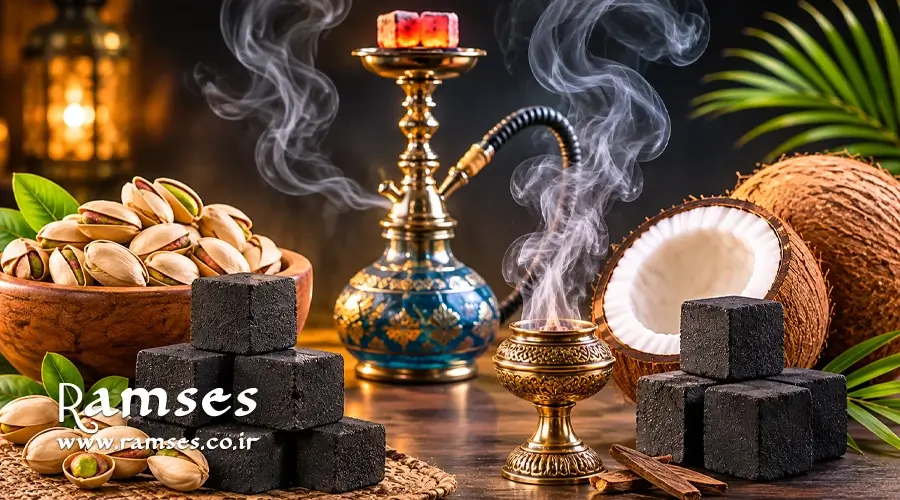
Choosing the right charcoal is important for hookah (shisha), incense, and other applications. Two popular options in the international charcoal market are pistachio charcoal and coconut charcoal, also known as coco charcoal.
Both types are produced from natural raw materials and can offer strong, stable heat when manufactured properly. However, they differ in their raw materials, manufacturing processes, market availability, and certain combustion characteristics.
So, which one is better? The answer depends on the intended application, product specifications, manufacturing quality, and the requirements of the target market.
In this article, we compare pistachio charcoal and coconut charcoal based on their raw materials, heat, burning time, odor, ash, density, and suitability for hookah and incense.
1. What Is Pistachio Charcoal?
Pistachio charcoal, also known as pistachio shell charcoal, is produced from pistachio shells through a carbonization process. These shells are used as a natural raw material and can be processed into different charcoal products.
In Iran, pistachio shells are an available agricultural by-product, making them an important raw material for charcoal production.
Pistachio charcoal is commonly used for hookah (shisha) and incense. Depending on the manufacturing process, it can be produced in different shapes and sizes, including cubes, hexagonal pieces, and other forms.
The final quality depends on several factors, including the quality and condition of the pistachio shells, the carbonization process, the pressure and density achieved during production, and the final product's moisture level and overall consistency.
These factors influence the charcoal's hardness, ignition behavior, heat performance, and burning characteristics.
2. What Is Coconut Charcoal?
If you are looking for Ramses hexagonal pistachio charcoal or Ramses pistachio charcoal cubes, you can visit our products page. Coconut charcoal is made from coconut shells through a carbonization process. It is widely known in the international market and is commonly used for hookah (shisha).
You may also find it under the name coco charcoal, particularly in product listings and commercial searches.
Coconut charcoal is often manufactured as compressed charcoal cubes and other shapes. Its quality can vary considerably depending on the raw material and production methods.
Important factors affecting coconut charcoal quality include the quality of the coconut shells, the carbonization process, the type and quality of any binding materials used, compression pressure, final density, moisture content, and manufacturing consistency.
Some coconut charcoal products can achieve high density, but this does not mean that every coconut charcoal product is necessarily denser or better than pistachio charcoal.
3. The Main Difference Between Pistachio and Coconut Charcoal
The most obvious difference is the raw material: pistachio charcoal is produced from pistachio shells, while coconut charcoal is produced from coconut shells.
However, raw material alone does not determine the final quality. Manufacturing methods and product specifications play an important role in the performance of both types.
For buyers, the most useful comparison is based on the actual product rather than the raw material name alone.
4. Heat and Burning Performance
Both pistachio charcoal and coconut charcoal can provide strong and stable heat when manufactured correctly.
There is no universal rule that one type always produces more heat than the other. Actual performance depends on the product's density, carbonization quality, moisture content, and manufacturing consistency.
For hookah users and commercial buyers, it is important to evaluate heat stability during use, consistency between individual pieces, ignition behavior, the amount of ash produced, and overall burning performance.
A properly manufactured product of either type can be suitable for hookah applications.
5. Burning Time and Hardness
Burning time and hardness are often important considerations when comparing charcoal products.
However, these characteristics are not determined by the raw material alone. The production process, compression, density, and carbonization quality can significantly affect the final result.
In practical terms, high-quality pistachio charcoal and high-quality coconut charcoal can have similar burning times and comparable hardness.
Buyers should therefore request product samples and evaluate the actual specifications before making large wholesale orders.
6. Odor and Suitability for Incense
Odor is one of the important differences buyers may consider, especially when choosing charcoal for incense.
Based on our practical observations of the pistachio charcoal we manufacture, the product may produce a slight odor during the initial ignition stage. However, after it becomes fully ignited and turns into embers, no noticeable odor remains.
This characteristic makes our pistachio shell charcoal a suitable option for incense applications, where preserving the fragrance of the incense is important.
Coconut charcoal may produce an odor during ignition and may continue to have a noticeable odor after becoming embers, depending on the product and its manufacturing quality.
These observations should not be treated as a universal rule for every product. Odor can vary between manufacturers and batches, so testing samples is recommended before choosing a supplier.
7. Ash and Density
Ash production and density are two additional factors that buyers should consider.
The amount and characteristics of ash depend on several variables, including the raw material, carbonization process, and manufacturing quality.
Similarly, coconut charcoal may have higher density in some products. However, density varies between manufacturers and product specifications, and it should not be assumed that all coconut charcoal is denser than all pistachio charcoal.
For wholesale buyers, it is useful to request technical specifications and compare samples under similar conditions.
8. Which Is Better for Hookah (Shisha)?
Both pistachio charcoal and coconut charcoal can be used for hookah (shisha).
The better option depends on the target market, customer preferences, product specifications, and price.
Coconut charcoal has a strong presence in the international hookah charcoal market. Pistachio charcoal, particularly Iranian pistachio shell charcoal, is also an established option in markets where buyers are familiar with its characteristics.
When selecting hookah charcoal, buyers should consider stable heat performance, suitable size and shape, consistent quality between batches, ignition characteristics, ash and odor, as well as packaging and wholesale availability.
To explore ready-made samples of Ramses hexagonal pistachio charcoal and Ramses pistachio charcoal cubes, visit our products page. There is no single winner for every market. The best choice is the product that meets the buyer's requirements and performs consistently.
9. Which Is Better for Incense?
For BBQ and heating applications, you can also check Ramses hexagonal compressed charcoal and Ramses compressed charcoal cube. For incense applications, odor after ignition is especially important because it can affect the fragrance experience.
Based on our practical observations, the pistachio charcoal we manufacture produces a slight odor during initial ignition, but no noticeable odor remains after it turns into embers.
This makes it a suitable choice for buyers looking for charcoal to use with incense while preserving its fragrance.
As with any charcoal product, buyers should test samples under their intended conditions before placing a large order.
10. Price, Market Availability, and Wholesale Purchasing
The prices of pistachio charcoal and coconut charcoal vary according to the country, market demand, raw material costs, manufacturing quality, packaging, and order quantity.
Coconut charcoal has broad international market recognition and is available from suppliers in different countries.
Pistachio charcoal offers another option, particularly for buyers interested in Iranian charcoal products and pistachio shell raw materials.
For importers, distributors, and wholesale buyers, the purchasing decision should not be based on price alone. It is important to compare product quality and consistency, available shapes and dimensions, packaging specifications, minimum order quantity, production capacity, shipping arrangements, and supplier reliability.
Requesting samples and technical details before placing a large order can help reduce purchasing risks. To get current prices and cooperation terms, use our price inquiry form.
Pistachio Charcoal vs. Coconut Charcoal: Comparison Table
| Feature | Pistachio Charcoal | Coconut Charcoal |
|---|---|---|
| Raw material | Pistachio shells | Coconut shells |
| Heat performance | Strong and stable when properly manufactured | Strong and stable when properly manufactured |
| Burning time | Depends on quality and production | Depends on quality and production |
| Hardness | Depends on density and compression | Depends on density and compression |
| Ignition | Depends on product specifications | Depends on product specifications |
| Odor during ignition | May have a slight odor | May have an odor |
| Odor after becoming embers | No noticeable odor in the pistachio charcoal we manufacture | May vary depending on the product |
| Ash | Depends on manufacturing quality | Depends on manufacturing quality |
| Density | Depends on production specifications | Can be higher in some products |
| Hookah (shisha) use | Suitable | Suitable |
| Incense use | Suitable, particularly when odor after ignition is minimal | Depends on the product's odor characteristics |
| Market availability | Varies by country | Widely recognized in international markets |
Conclusion: Which Charcoal Should You Choose?
Pistachio charcoal and coconut charcoal are both useful products for hookah (shisha) and other applications. Neither type is automatically better in every situation.
Coconut charcoal, also known as coco charcoal, has broad recognition in international markets. Pistachio charcoal, particularly Iranian pistachio shell charcoal, offers an alternative with its own characteristics and applications.
For incense buyers, the odor characteristics after ignition may be an important consideration. Based on our practical observations, the pistachio charcoal we manufacture has no noticeable odor after becoming embers, making it a suitable option for incense.
Ultimately, the right choice depends on your market, intended application, required specifications, and supplier quality. Comparing samples is the best way to make an informed purchasing decision.
Looking for an Iranian pistachio charcoal supplier? Contact Ramses Charcoal to learn more about our products, available specifications, and wholesale supply options.
Ramses hexagonal pistachio charcoal | Ramses pistachio charcoal cubes | Request a quote