Compressed charcoal made from sawdust and compressed charcoal made from bamboo have attracted attention in local and international markets, particularly for grilling, heating, and some industrial applications. As demand for compressed charcoal and alternatives made from plant waste continues to grow, many consumers, traders, and importers are looking to understand the difference between sawdust charcoal and bamboo charcoal. They want to know which type provides better heat, burns longer, and offers higher quality.
Although both types are made from plant based raw materials, they differ in terms of raw material sources, manufacturing methods, density, hardness, heat output, ash content, and cost. Charcoal quality cannot be determined by the raw material alone, because carbonization, drying, compression, and overall manufacturing quality have a direct impact on the properties of the final product.
In this article, we will explain the differences between compressed sawdust charcoal and bamboo charcoal, discuss the advantages and disadvantages of each type, and highlight the most important factors to consider before buying charcoal for personal or commercial use.
1. What Is Sawdust Charcoal?
Sawdust charcoal is a type of compressed charcoal produced using waste materials from wood processing, such as sawdust and wood powder generated during sawing and manufacturing operations. These raw materials can be used to produce fuel instead of being left unused.
The wood materials used in charcoal production go through preparation, processing, and carbonization. Depending on the manufacturing method and the type of product required, they may then be ground and compressed. The compression and shaping process makes it possible to produce charcoal pieces in different sizes and shapes to meet commercial and industrial requirements.
The properties of sawdust charcoal vary depending on the type of wood used, moisture content, degree of carbonization, compression level, and manufacturing method. This is why charcoal quality can differ significantly from one factory to another, even when both manufacturers use sawdust as their raw material.
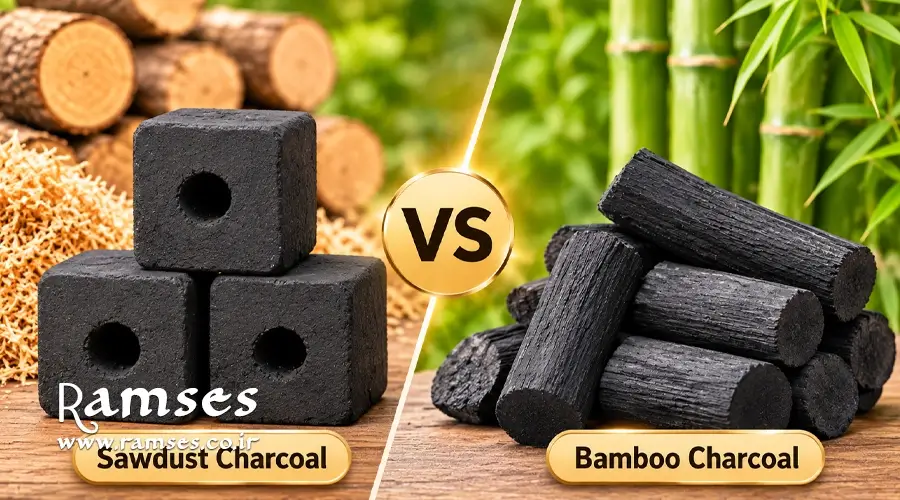
Some of the main commercial forms of compressed charcoal include cube shaped charcoal with a hole in the center, quadrangular charcoal, and hexagonal charcoal. These products differ in design, size, and intended use.
2. What Is Bamboo Charcoal?
Bamboo charcoal, also known as charcoal made from bamboo, is produced from bamboo stalks or bamboo waste after suitable preparation and heat treatment.
Bamboo grows faster than many types of trees. Different parts of the plant and its processing waste can also be used to manufacture various products, including charcoal for certain energy, grilling, and heating applications.
Bamboo charcoal production usually begins with preparing and drying the raw material. The material is then converted into charcoal through a carbonization process. The resulting charcoal can be used in its natural form or ground and compressed to produce briquettes in different shapes and sizes.
It is important to distinguish between natural bamboo charcoal and compressed bamboo charcoal. Natural bamboo charcoal may be produced by carbonizing pieces of bamboo, while compressed bamboo charcoal can be manufactured from bamboo powder or waste after carbonization, grinding, and compression. As a result, the properties of products available on the market can vary considerably.
3. The Difference Between Sawdust Charcoal and Bamboo Charcoal in Terms of Raw Materials
The main difference between these two types of charcoal begins with the source of their raw materials.
Sawdust charcoal is made from wood waste generated by sawing and wood processing operations, while bamboo charcoal is made from bamboo plants or their waste materials.
Each raw material has natural characteristics that affect the production process. The type of wood used in compressed charcoal can influence its density, ash content, and thermal properties. Similarly, the bamboo species, its age, and the way it is prepared can affect the quality of the resulting charcoal.
From an environmental perspective, using sawdust and wood waste can help make better use of leftover materials from the wood industry. Using bamboo waste can also add value to materials left over from the production of bamboo products.
However, neither type can be considered more sustainable in every situation. Sustainability depends on the source of the raw materials, how they are obtained, the energy consumed during manufacturing, and waste management practices.
4. Which Produces More Heat: Sawdust Charcoal or Bamboo Charcoal?
Heat output is one of the most important factors consumers consider when choosing charcoal, whether for grilling, heating, or certain industrial applications.
There is no fixed rule proving that sawdust charcoal always produces more heat than bamboo charcoal, or the other way around. Heat output depends on several factors, including:
- The type and quality of the raw material.
- The degree of carbonization and how complete the process is.
- The moisture content of the charcoal.
- Density and compression level.
- The size and shape of each charcoal piece.
- The proportions of fixed carbon, volatile matter, and ash.
It is also important to distinguish between heat intensity and heat stability. Charcoal may produce high heat at the beginning of use but may not maintain the same level throughout the entire burning period. Therefore, it is better to evaluate charcoal through practical testing that measures heat output and stability over time rather than relying only on the initial impression.
5. The Difference Between Sawdust Charcoal and Bamboo Charcoal in Burning Time
Burning time is an important factor when choosing charcoal, especially for restaurants, charcoal traders, and consumers who need fuel that lasts for a suitable period without frequent replacement.
The burning time of sawdust charcoal is affected by its degree of carbonization, density, moisture content, and piece size. Bamboo charcoal is influenced by the same factors, as well as the characteristics of the bamboo species and the method used to convert it into charcoal.
In some conditions, high density charcoal may burn for a longer period. However, density alone is not enough to determine burning time. Airflow, piece size, and the required temperature must also be considered.
Therefore, when comparing the two products, it is recommended to test pieces with similar weights and dimensions under comparable burning conditions. This makes it possible to determine which product provides a more suitable burning time for the intended application.
6. Differences in Hardness, Density, and Ease of Transportation
Hardness and density affect charcoal quality during storage, transportation, and use. These factors are particularly important when purchasing large quantities for export or commercial distribution.
Compressed charcoal made from sawdust can have good hardness when the grinding, mixing, compression, and drying processes are properly controlled. Good manufacturing quality helps reduce breakage during packaging and transportation.
The hardness of bamboo charcoal, on the other hand, depends on whether the product is natural charcoal or compressed charcoal. The type of raw material and the manufacturing method also influence this property.
It is not accurate to say that bamboo charcoal is always harder or that sawdust charcoal always breaks more easily. The correct way to evaluate these properties is to test actual charcoal pieces and observe the amount of breakage and dust produced during handling.
Importers and wholesale buyers are advised to request samples from suppliers before signing a contract. They should check the charcoal's structural strength and resistance to breakage, especially when the shipment will be transported over long distances.
7. Differences in Ash Content, Smoke, and Odor
Ash content, smoke, and odor are important indicators when evaluating charcoal quality.
The amount of ash left after combustion depends on the proportion of minerals and non combustible materials in the raw material, as well as the quality of the manufacturing and carbonization processes.
Smoke and odor can be affected by moisture content, volatile matter, how complete the carbonization process is, and any additional materials used during manufacturing.
It cannot be stated that bamboo charcoal always produces less ash than sawdust charcoal, or that either type is completely odorless under all conditions. These properties vary between manufacturers and products.
If you are looking for charcoal suitable for grilling or heating, it is better to test the product and observe the amount of smoke, odor, and ash during different stages of combustion. You should also make sure that the charcoal is intended for your specific application and does not contain additives that are unsuitable for that use.
8. Advantages and Disadvantages of Sawdust Charcoal
Main Advantages of Sawdust Charcoal
1. Making Use of Wood Waste
Using sawdust and wood powder helps turn waste from the wood industry into a product that can be used and marketed.
2. Production in Different Shapes and Sizes
Compressed charcoal made from sawdust can be manufactured in various shapes, such as cube shaped charcoal with a hole in the center, quadrangular charcoal, and hexagonal charcoal, allowing manufacturers to meet the requirements of different markets.
3. Greater Control Over Product Specifications
Grinding, mixing, compression, and carbonization processes allow manufacturers to control several properties of the final product, depending on their equipment and manufacturing methods.
4. A Variety of Applications
Some sawdust charcoal products can be used for grilling, heating, and industrial applications. Other products are also manufactured for specific uses according to their specifications.
5. Suitable for Commercial Production
Compression and shaping make it possible to produce pieces with relatively uniform shapes and sizes, which is important for packaging, storage, and distribution.
Disadvantages of Sawdust Charcoal
- Product quality can vary significantly from one manufacturer to another.
- Raw material, transportation, and manufacturing costs can affect the final price depending on the country of production.
- Maintaining consistent quality across all shipments requires close monitoring of the production process.
9. Advantages and Disadvantages of Bamboo Charcoal
Main Advantages of Bamboo Charcoal
1. A Fast Growing Plant Based Raw Material
Bamboo grows faster than many types of trees and can provide a renewable source of raw materials when cultivated and managed sustainably.
2. The Ability to Use Bamboo Waste
Parts of bamboo plants and waste generated during manufacturing can be used to produce charcoal or compressed briquettes.
3. Potential for Good Thermal Properties
Studies on different bamboo species have shown the possibility of producing charcoal briquettes with good thermal and mechanical properties. However, the results vary depending on the bamboo species and production conditions.
4. A Variety of Applications
Bamboo charcoal is used in some cooking, heating, and energy applications. After suitable processing, it can also be used in other industries.
Disadvantages of Bamboo Charcoal
- Its properties vary depending on the type of bamboo used.
- Proper preparation and carbonization are required to achieve consistent quality.
- Its hardness and density can vary between products.
- Not all bamboo charcoal products can be assumed to be suitable for hookah, grilling, or industrial applications without checking their specifications.
- Raw material, transportation, and manufacturing costs can affect the final price depending on the country of production.
10. Comparison Table: Sawdust Charcoal vs Bamboo Charcoal
| Comparison Criteria | Sawdust Charcoal | Bamboo Charcoal |
|---|---|---|
| Raw Material | Sawdust and wood powder | Bamboo stalks or bamboo waste |
| Production Method | Processing, carbonization, and compression depending on the product | Carbonization, which may be followed by grinding and compression |
| Heat Output | Depends on manufacturing quality | Depends on the bamboo species and manufacturing quality |
| Burning Time | Varies according to density, size, and carbonization | Varies according to density, size, and carbonization |
| Hardness | Depends on compression and drying quality | Depends on the raw material and manufacturing method |
| Ash Content | Varies according to the raw material and carbonization | Varies according to the bamboo species and carbonization |
| Smoke and Odor | Depend on moisture and the completeness of carbonization | Depend on moisture and the completeness of carbonization |
| Shapes | Cube, quadrangular, hexagonal, and other shapes | Natural or compressed in different shapes |
| Applications | Grilling, heating, and some industrial applications depending on the product | Cooking, heating, and some energy applications |
| Environmental Sustainability | Depends on the source of wood waste and the production method | Depends on bamboo cultivation and resource management |
11. Which Is Better for Grilling and Heating: Sawdust Charcoal or Bamboo Charcoal?
The answer depends on the intended application and the specifications required by the user.
If the purpose is grilling, it is important to choose charcoal that provides suitable and stable heat, does not break apart easily, and does not produce unwanted smoke or odor during use. The product should also be specifically intended for food preparation and grilling.
For heating applications, attention should be given to burning time, heat output, operating cost, and ease of storage. You should also make sure that the type of charcoal is suitable for the heating appliance being used.
Compressed sawdust charcoal can be a suitable option for people looking for uniform shapes and a variety of commercial products. Bamboo charcoal may also be a suitable choice for consumers who have access to high quality products with specifications that meet their needs.
The best approach is always to compare actual samples of both products under similar operating conditions rather than choosing charcoal based only on the name of its raw material.
12. How to Choose the Right Compressed Sawdust Charcoal
If you are looking for sawdust charcoal for commercial use or wholesale purchasing, it is important to consider several factors before making a purchase:
- Check the type and source of the raw material.
- Examine the moisture content and carbonization quality.
- Test the hardness of the charcoal and its resistance to breaking apart.
- Measure heat output and burning time under comparable conditions.
- Check the amount of ash remaining after combustion.
- Observe smoke and odor during ignition and after combustion is complete.
- Choose the shape and size that best suit the intended application.
- Compare the final price after calculating packaging, shipping, and transportation costs.
For importers and wholesale buyers, a low price per ton is not enough. It is important to calculate the actual cost of use and compare heat output, burning time, and product quality with the price paid.
13. Ramses Compressed Sawdust Charcoal Products
Ramses offers a range of compressed charcoal products made from clean sawdust in different shapes to meet the needs of customers and commercial markets. These products vary in shape, size, and intended use, providing importers and wholesale buyers with several options when choosing charcoal for their requirements.
Compressed Charcoal Cube
This product has a cube shape with a hole in the center. It is designed for grilling, and its product page also presents hookah and heating applications. It is made from high quality raw materials using clean sawdust, according to the specifications provided on the product page.
To learn more about this product, visit the Ramses Compressed Charcoal Cube product page.
Compressed Charcoal Quadrangular
This product is shaped like a quadrangular bar and is made from clean sawdust after processing and compression. According to its product page, it can be used for grilling, heating, and cooking. It is an available option for customers looking for compressed charcoal in this shape.
You can find more details on the Ramses Compressed Charcoal Quadrangular product page.
Compressed Charcoal Hexagon
This product has a hexagonal shape and is made from clean sawdust through a compressed charcoal production process. According to its product page, it is suitable for grilling and heating. It is an option for customers who prefer this charcoal design.
To learn more, visit the Ramses Compressed Charcoal Hexagon product page.
Ramses provides the opportunity to request price quotations and obtain information about order quantities and supply terms. Importers and wholesale buyers can contact the company for further information about available products and export arrangements, or use the price inquiry form.
Conclusion: Is Sawdust Charcoal Better Than Bamboo Charcoal?
Sawdust charcoal and bamboo charcoal differ in their raw material sources and manufacturing methods. However, the quality of the final product is the most important factor when comparing them.
Compressed sawdust charcoal can offer consumers a variety of shapes and sizes. It also provides an opportunity to make better use of wood waste in charcoal production. Bamboo charcoal, on the other hand, is a plant based alternative that can offer desirable properties when suitable raw materials are used and proper manufacturing processes are followed.
If you are looking for compressed charcoal in different shapes for commercial use, grilling, cooking, or heating, you can explore the three Ramses products: Compressed Charcoal Cube, Compressed Charcoal Quadrangular, and Compressed Charcoal Hexagon. Compare their available specifications with your requirements before making a purchase.
For information about prices, order quantities, and supply terms, contact the Ramses team and request details about the product that best suits your market.