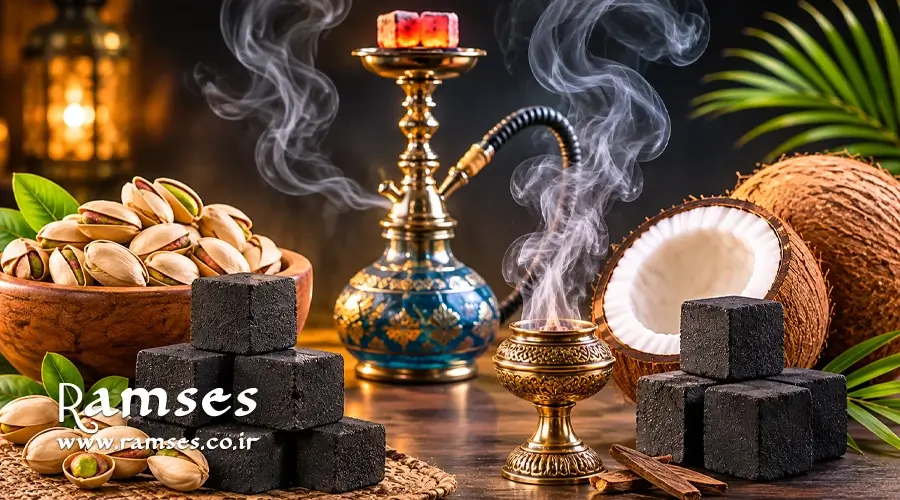
Pistachio shell charcoal manufacturing is an industry that combines the use of agricultural byproducts with the production of natural charcoal for different applications. After pistachio kernels are removed, the shells remain and can be used as a raw material for charcoal production instead of being treated as waste with no economic value.
Pistachio charcoal production is particularly relevant in Iran because pistachios and the shells generated during processing are widely available. However, producing charcoal from pistachio shells involves more than simply obtaining the raw material. It requires selecting suitable shells, preparing and drying them, converting them into charcoal through carbonization, and then grinding, compressing, and shaping the material according to the required specifications.
In this guide, we explain the main stages of pistachio shell charcoal manufacturing, the factors that influence its quality, the differences between cube and hexagonal shapes, and the pistachio charcoal products offered by Ramses, including their specifications and applications.
1. What Is Pistachio Shell Charcoal?
Pistachio shell charcoal is a type of natural charcoal produced using pistachio shells as its raw material. The process begins with collecting the shells left over from pistachio processing. These shells are then cleaned, dried, and prepared for carbonization.
During carbonization, the shells are heated inside specially designed kilns under suitable production conditions. This process converts the plant material into a carbonaceous material. After carbonization is complete and the charcoal has cooled, it can be ground into powder and used in compression and shaping processes to produce charcoal briquettes in different shapes and sizes.
Pistachio shell charcoal is different from coconut charcoal, also known as coco charcoal, in terms of its raw material. Pistachio charcoal is made from pistachio shells, while coconut charcoal is made from coconut shells. These names therefore refer to two different types of charcoal, even though both are forms of natural charcoal.
2. Why Are Pistachio Shells Used for Charcoal Production?
Pistachio processing generates large quantities of shells after the kernels are separated from their outer coverings. These shells can be used in several ways, including the production of natural charcoal.
There are several reasons why pistachio shells are used as a raw material:
Making use of agricultural byproducts: Charcoal production provides a way to convert shells generated during pistachio processing into a material with economic value instead of disposing of them without further use.
Availability of local raw materials: Pistachio shells are available in regions where pistachios are cultivated and processed. This makes it possible to use locally available resources.
Producing different charcoal products: After the shells are processed, carbonized, ground, and compressed, they can be shaped into charcoal briquettes in different forms and sizes to meet various market requirements and applications.
However, not all pistachio shells have the same quality, thickness, or physical characteristics. Selecting suitable shells is therefore an important step at the beginning of the production process.
3. Does Pistachio Shell Quality Vary Between Regions in Iran?
Yes. Pistachio shells from different regions of Iran may vary in thickness, quality, and physical specifications. It is therefore not accurate to assume that all shells available in the market have identical characteristics or produce the same results when used for charcoal manufacturing.
Ramses addresses these differences by seeking to source pistachio shells that meet defined quality standards and selecting suitable raw materials from the varieties available in the market.
This step is important because raw material quality affects the later stages of production. Differences in shell characteristics may also influence the properties of the finished charcoal.
For this reason, producing good quality pistachio charcoal does not begin only at the kiln or compression machine. It starts with selecting and inspecting suitable shells before they enter the production line.
4. Stages of Pistachio Shell Charcoal Manufacturing
At Ramses, pistachio shell charcoal production involves several connected stages, beginning with shell preparation and ending with charcoal shaping. The quality of each stage contributes to the specifications of the final product.
Stage 1: Collecting Pistachio Shells and Selecting Raw Materials
The manufacturing process begins with collecting pistachio shells generated during shelling and processing operations. At this stage, the main focus is selecting suitable shells according to the required quality standards.
Selection is not based on availability alone. Differences in thickness and physical characteristics between shells from different regions and sources are also considered.
Ramses aims to source shells that meet the required quality level because selecting suitable raw materials is an important foundation for producing a finished product with consistent specifications.
Stage 2: Cleaning and Drying the Shells
After the shells have been selected, they are cleaned to remove impurities and unwanted materials that may be attached to them.
The shells then undergo a drying process to reduce their moisture content before carbonization.
Moisture is one of the factors that must be controlled during raw material preparation. The condition of the shells before they enter the kiln affects the processing conditions and the efficiency of the production process.
Stage 3: Carbonizing Pistachio Shells in Kilns
Carbonization is one of the most important stages in pistachio shell charcoal manufacturing. During this stage, the shells are placed inside specially designed kilns and heated to convert the plant material into a carbonaceous material.
During carbonization, some of the organic compounds in the shells decompose, and the raw material gradually turns into charcoal.
Carbonization conditions influence the properties of the resulting charcoal. Important considerations include the quality of the treatment process and how completely the raw material has been converted into carbonaceous material.
Charcoal quality cannot be determined only by looking at the colour or external appearance of the pieces. Its properties and the results of laboratory tests should also be considered.
Stage 4: Cooling and Sorting the Charcoal
After carbonization is complete, the resulting charcoal must be cooled before moving to the next processing stages.
The material can then be sorted and prepared for grinding. This stage helps prepare the charcoal for the remaining manufacturing operations.
It is also important to handle the charcoal appropriately after carbonization because it has been exposed to high temperatures during production.
Stage 5: Grinding the Charcoal into Powder
After cooling and preparation, the charcoal produced from pistachio shells is ground into charcoal powder.
Grinding is necessary to prepare the carbonaceous material for compression and shaping. It also helps produce a more uniform material for manufacturing briquettes.
The quality of compressed charcoal depends on several factors, including the quality of the charcoal produced during carbonization, the characteristics of the powder, and the compression and shaping methods.
Stage 6: Preparing and Compressing the Powder
After grinding, the charcoal powder is prepared for compression. A suitable binding material is used as part of the production formulation. The type and proportion of the binding material should not be assumed to be the same for every type of charcoal.
The powder is then compressed using specialised equipment to produce cohesive briquettes in the required shapes and dimensions.
Compression is an important stage in manufacturing compressed charcoal because it affects the cohesion, density, and hardness of the pieces. These properties are important during packaging, transportation, and use.
Stage 7: Shaping the Charcoal into Different Sizes
After the material has been prepared and compressed, it is shaped according to the moulds used in the production line.
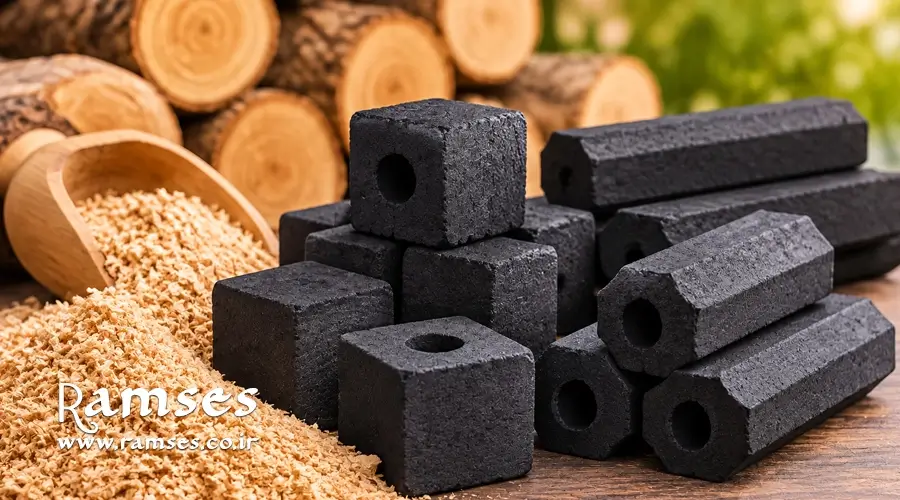
This stage allows pistachio shell charcoal to be produced in different forms, including cube or square briquettes and long hexagonal pieces.
The shape and size depend on market requirements and the intended application. For this reason, Ramses offers pistachio charcoal products in more than one size.
5. What Factors Affect the Quality of Pistachio Shell Charcoal?
The quality of pistachio charcoal does not depend on the raw material alone. It is influenced by several factors throughout the manufacturing process. The most important include:
Shell quality: Pistachio shells vary in thickness and physical characteristics. Selecting suitable raw materials helps maintain production quality.
Drying: The moisture content of the material before carbonization is important. This makes drying an essential part of shell preparation.
Carbonization: The quality of the carbonization process affects the chemical properties of charcoal, including fixed carbon and volatile matter content.
Grinding and uniformity: Properly preparing the charcoal and converting it into suitable powder helps prepare the material for compression.
Compression and shaping: These processes affect the cohesion, hardness, and density of the briquettes.
Therefore, evaluating charcoal quality requires looking at the production stages and laboratory test results, rather than judging the product by its appearance alone.
6. Laboratory Test Results for Ramses Hexagonal Pistachio Charcoal
Laboratory testing is an important method for evaluating charcoal. It helps identify several properties related to the composition and quality of the material.
An accredited laboratory test was conducted on a sample of Ramses pistachio charcoal. The reported results were as follows:
| Test Parameter | Result |
|---|---|
| Fixed Carbon | 82.7% |
| Ash | 4.1% |
| Volatile Matter | 13.2% |
| Moisture | 1.4% |
What Do These Results Mean? — Fixed Carbon: 82.7%
Fixed carbon is an important parameter when evaluating charcoal. It represents the proportion of carbon remaining according to the applied testing method. This percentage helps provide an understanding of the carbon composition of the tested sample.
Ash: 4.1%
Ash refers to the non combustible material remaining after charcoal burns under the specified test conditions. Ash content is an important factor in charcoal evaluation, particularly for applications where the amount of residue matters.
Volatile Matter: 13.2%
Volatile matter refers to compounds released from charcoal when it is heated under the specified test conditions. This property is related to the composition of the charcoal and its combustion behaviour.
Moisture: 1.4%
Moisture content represents the amount of water present in the sample at the time of testing. It is an important property because it is related to storage conditions, ignition, and product characteristics.
7. Types and Shapes of Ramses Pistachio Shell Charcoal
Ramses manufactures pistachio shell charcoal according to its established production standards. However, fixed carbon content may vary between different charcoal types or product specifications.
The company offers two main products in different shapes and dimensions to meet the needs of customers and markets.
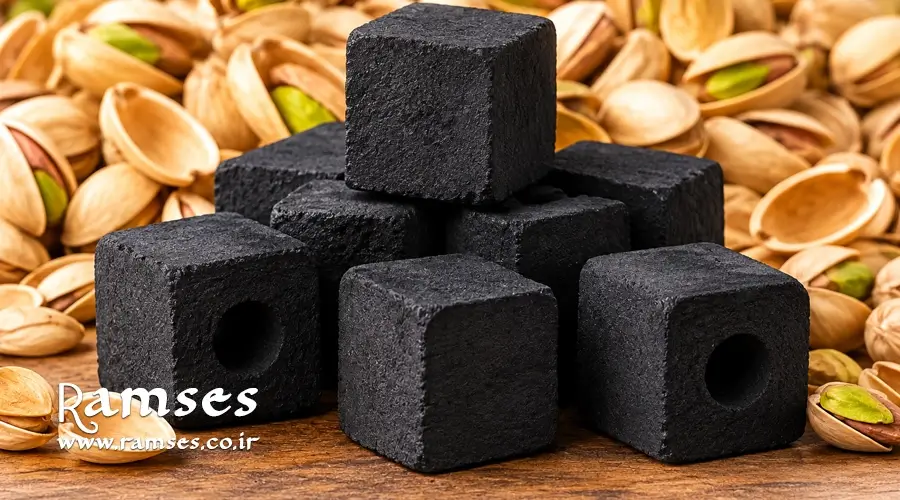
First: Pistachio Charcoal Cube
This product has a cube or square shape and is available in several sizes, allowing customers to select the dimensions that best suit their applications.
Available sizes:
| Dimensions | Briquette Type |
|---|---|
| 25 × 25 × 25 mm | Cube |
| 28 × 28 × 28 mm | Cube |
| 30 × 30 × 30 mm | With hole and without hole |
| 37 × 37 × 30 mm | With hole |
These options give customers flexibility when choosing charcoal dimensions and shapes, whether they require smaller cube briquettes or larger sizes.
To learn more about this product and view its specifications, visit the Ramses Pistachio Charcoal product page.
Second: Pistachio Charcoal Hexagon
Ramses hexagonal pistachio charcoal is produced as long hexagonal pieces and is available in several dimensions to meet different customer requirements.
Available sizes:
| Dimensions | Shape |
|---|---|
| 25 × 25 × 50 mm | Hexagonal |
| 28 × 28 × 50 mm | Hexagonal |
| 30 × 30 × 50 mm | Hexagonal |
This product differs from cube briquettes in its shape and length, giving customers another option when selecting pistachio shell charcoal.
For more details and available dimensions, visit the Ramses Pistachio Charcoal Hexagon product page.
8. What Is the Difference Between Pistachio Charcoal and Coconut Charcoal?
The main difference between these two types of charcoal is the raw material used in their production.
Pistachio charcoal is made from pistachio shells, while coconut charcoal, also known as coco charcoal, is made from coconut shells. Both types undergo processing and carbonization. The resulting carbonaceous material can then be ground and compressed to produce charcoal briquettes.
However, using different raw materials does not automatically mean that one type is always better than the other. The characteristics of the finished charcoal are also influenced by raw material quality, carbonization, grinding, compression, and other manufacturing processes.
Some of the factors that can be compared when evaluating different charcoal products include:
- Fixed carbon content
- Ash content
- Moisture content
- Volatile matter
- Charcoal hardness and density
- Heat stability and burning duration
- Odour during ignition and after the charcoal has become fully glowing embers
For more details, read the article Pistachio Charcoal vs Coconut Charcoal.
9. Applications of Pistachio Shell Charcoal
Pistachio shell charcoal can be used in more than one application. Two of the main uses of Ramses products are hookah and incense.
Pistachio Charcoal for Hookah and Shisha
Charcoal is used in hookah and shisha to provide a source of heat during use. Heat stability, burning duration, ash content, and odour are among the factors that consumers and traders consider when selecting charcoal.
Ramses focuses on producing pistachio charcoal that provides strong and stable heat, while paying attention to product characteristics and manufacturing quality.
Pistachio Charcoal for Incense and Oud
Charcoal is also used to burn incense and oud. In this application, the odour produced by the charcoal itself is an important consideration because the aim is to enjoy the fragrance of the incense without unwanted interference from the charcoal.
10. Why Choose Ramses Pistachio Shell Charcoal?
Ramses manufactures pistachio shell charcoal according to established production standards, with attention to raw material selection and the different stages of processing, carbonization, grinding, compression, and shaping.
The company offers two main product types:
- Pistachio Charcoal Cube: Available in several sizes, with drilled and non drilled options for selected dimensions.
- Pistachio Charcoal Hexagon: Available in different dimensions.
Laboratory test results are also available for a sample of pistachio charcoal, including fixed carbon, ash, volatile matter, and moisture percentages.
These products provide different options for customers looking for pistachio charcoal for hookah or incense applications. Importers and wholesalers can also compare the available shapes, dimensions, and specifications before selecting a suitable product.
Conclusion: How Are Pistachio Shells Turned into High Quality Charcoal?
Pistachio shell charcoal manufacturing begins with selecting suitable shells, followed by cleaning and drying. The shells are then carbonized inside specially designed kilns. After the charcoal has cooled and been ground, the powder is prepared for compression and shaping into cube briquettes or hexagonal pieces in different dimensions.
The quality of the finished product depends on several factors, starting with the characteristics of the shells and continuing through carbonization, preparation, compression, shaping, and laboratory testing.
Ramses offers pistachio shell charcoal in two main forms: cube briquettes and hexagonal pieces. Different sizes are available, and laboratory test results are provided for a sample of the hexagonal pistachio charcoal.
If you are looking for pistachio shell charcoal or would like to learn more about the available dimensions and specifications, visit the Ramses product pages to review the technical details of each product.
Ramses Pistachio Charcoal Cube | Ramses Pistachio Charcoal Hexagon | Request a Quote